
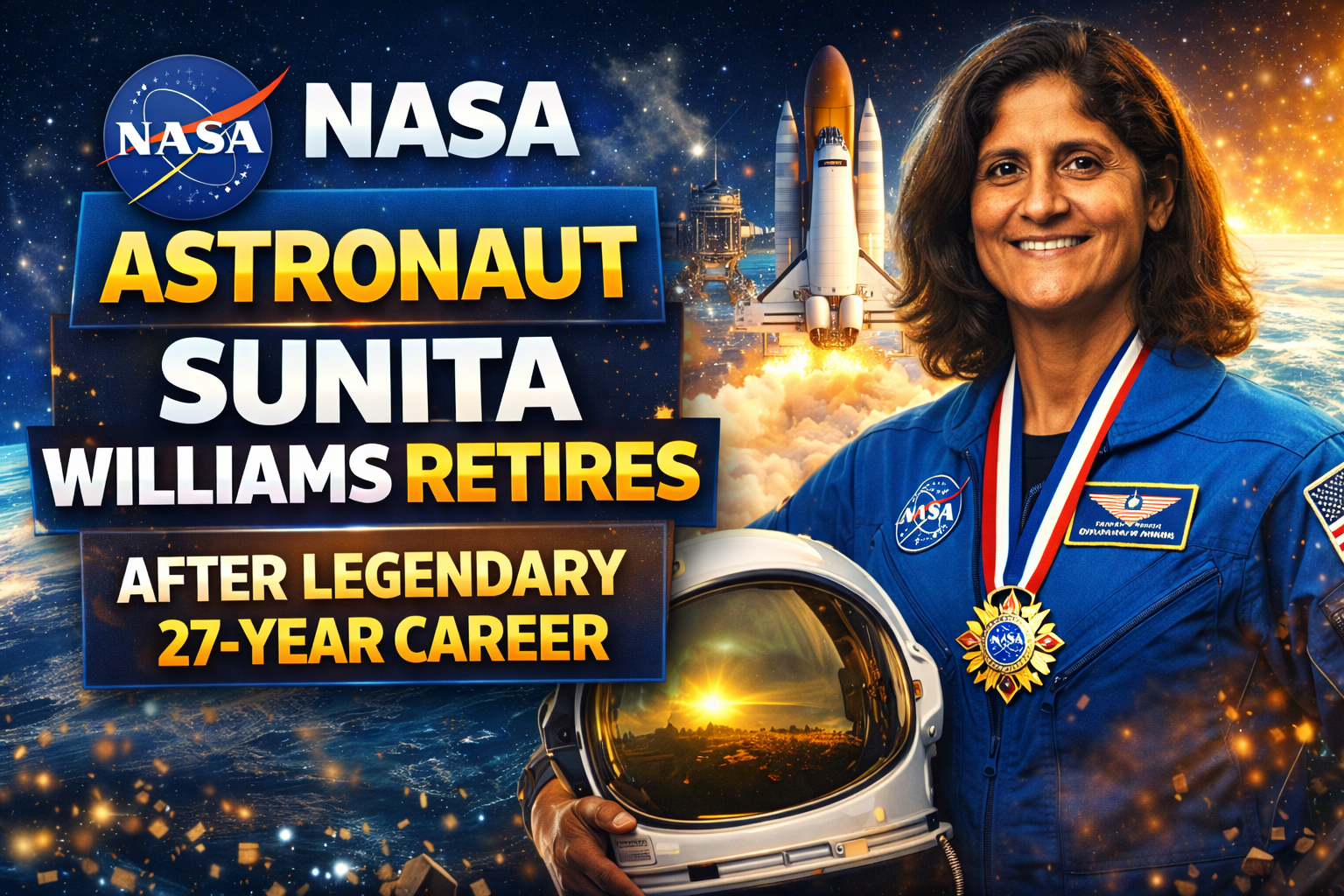
NASA Astronaut Sunita Williams Retires: The End of a Stellar Era
When the news first broke that NASA astronaut Sunita Williams retires after nearly three decades of service, many around the world paused to reflect on the extraordinary journey of a woman whose life was defined by courage, perseverance, and a deep passion for space exploration. Williams’s retirement — officially effective December 27, 2025 — marked the end of a remarkable 27-year career with the U.S. space agency that saw her push boundaries, shatter records, and inspire countless people across the globe.
Williams is not just another astronaut in NASA’s history; she is one of its most accomplished, with achievements that span far beyond the cumulative numbers of days spent in orbit. Her story is one of breaking barriers, leading with grace under pressure, and serving as a beacon for future generations of explorers.
From Ohio to Orbit: The Making of a Space Pioneer
Born in 1965 in Euclid, Ohio, Sunita Lyn Williams grew up with a curiosity for flight and the natural world, a passion that eventually led her to the United States Naval Academy and later to earn her Master’s degree in engineering. Her early life was shaped by a blend of American opportunity and her Indian-Slovenian heritage — her father was born in Gujarat, India — giving her a global perspective that would later resonate with international audiences.
Williams began her NASA journey when she was selected into the astronaut corps in 1998, a time when women in space were still only slowly carving their place in an overwhelmingly male field. From the very beginning she demonstrated technical skill, leadership, and an unshakeable calm under stress — qualities that would define her long and storied career.
The Numbers Behind the Legacy
To fully appreciate why NASA astronaut Sunita Williams retires as a figure of monumental importance, it helps to look at the sheer scale of her accomplishments:
Career Highlights Table
| Career Milestone | Achievement |
|---|---|
| Years at NASA | 27 years (1998–2025) |
| Total Days in Space | 608 days |
| Spacewalks | 9 |
| Total EVA Time | 62 hours, 6 minutes |
| Missions Flown | 3 aboard the ISS |
| Historic Firsts | First woman to run a marathon in space |
These numbers are not just statistics; they are chapters in a life devoted to pushing human limits. Williams’s 608 days in orbit place her among the most experienced astronauts in NASA history, second only to a handful of others in cumulative time in space.
Three Missions, Three Chapters
Williams’s spaceflight story spans three major missions, each with its own challenges and triumphs. Her first journey into orbit came aboard the Space Shuttle Discovery in 2006, where she served as flight engineer on Expeditions 14 and 15. It was a formative experience that showcased her skill in both science operations and spacewalks.
Her second mission in 2012 aboard a Russian Soyuz spacecraft saw her commanding Expedition 33 and further solidifying her reputation as a versatile and dependable leader on the International Space Station (ISS).
But it was Williams’s third mission that etched her name most deeply into modern space lore. In June 2024, she launched aboard Boeing’s Starliner spacecraft for what was to be a short test flight. Due to unexpected technical issues with the spacecraft, the mission shifted dramatically. Rather than returning after a planned eight-day test flight, Williams and her colleague remained aboard the ISS for more than nine months — an unplanned odyssey that turned into one of the longest consecutive stays in space by a NASA astronaut.
This extraordinary extension was not just a logistical challenge; it tested personal endurance, adaptability, and psychological resilience. Though dubbed “stuck in space” by some critics, Williams has always spoken about the mission with a focus on teamwork and the scientific value of the work she and her crewmate carried out during that unexpected extension.
What It Was Like to Live and Work Nine Months Aloft
While numbers tell part of the story, what truly humanizes NASA astronaut Sunita Williams retires as a narrative is the personal experience behind those long months in orbit. Being aboard the ISS is physically demanding — microgravity affects muscle mass, bone density, and even psychological well-being. It requires constant adjustments and routines that Earth-bound humans could scarcely imagine.
Williams and her crew responded not just to their duties — which included scientific experiments, spacewalks, and routine ISS operations — but also to the peculiar realities of life in space. They maintained communication with Earth, celebrated milestones with their families through video messages, and even found novel ways to maintain physical fitness. Williams’s decision to run a marathon on a treadmill aboard the ISS during an earlier mission — participating virtually in the Boston Marathon — underscores her belief in blending human spirit with scientific rigour.
Legacy Beyond the Numbers
When people talk about why NASA astronaut Sunita Williams retires matters, they are often referring to the legacy she leaves behind — not merely the records she set. Williams’s career helped solidify the importance of long-duration space missions at a time when NASA’s goals are shifting toward the Moon and Mars through programs like Artemis. Her insights into life aboard the ISS contribute to future planning for missions that may go months or years beyond low Earth orbit.
Her record-setting EVA time — 62 hours and six minutes outside a spacecraft — isn’t just a metric. It is a testament to her technical skill, calm in high-stakes situations, and dedication to advancing human presence in space.
Reflections from the Helm of NASA
NASA’s leadership has openly praised Williams for her contributions. Administrator Jared Isaacman described her as a “trailblazer in human spaceflight,” highlighting the breadth of her achievements and her role in paving the way for future explorers. Colleagues often speak of her not only as an exceptional astronaut but as a mentor and leader who embodied the collaborative spirit essential for success in space exploration.
This sentiment was echoed in tributes from fellow astronauts and scientists worldwide, many of whom credit Williams with mentoring younger astronauts, contributing to mission-critical training programs, and expanding international cooperation in space science.
What’s Next: The Future Beyond NASA
Retirement for someone like Sunita Williams is not a retreat but a transition. In her public appearances post-NASA — including engagements with students and science communities — she speaks passionately about empowering young people to pursue STEM careers and view space exploration as a shared human endeavour.
As NASA turns its focus toward Artemis missions and deep space exploration, Williams’s legacy will live on in the systems, procedures, and inspiration she helped build. Her career serves as a bridge between the era of International Space Station operations and the next frontier of human presence beyond Earth.
Conclusion: More Than a Career
When we reflect on the announcement that NASA astronaut Sunita Williams retires, we recognize it as more than just a career milestone. It is a celebration of human endurance, scientific curiosity, and leadership under conditions few will ever experience firsthand. Her time in space — especially the unprecedented extended mission — challenged assumptions about what is possible and expanded the boundaries of human exploration.
In stepping away from NASA, Williams leaves behind a legacy that will continue to shape spaceflight for years to come, inspiring those who look skyward with wonder and the ambition to push further than ever before.